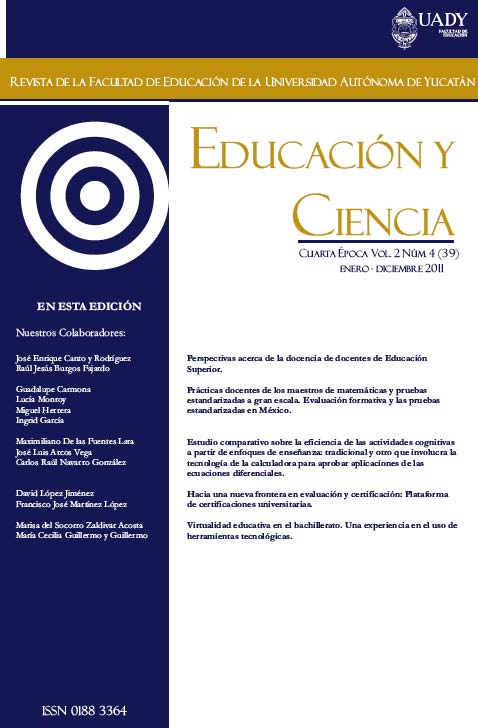
Mathematics teaching practices and large-scale standardized tests. Formative evaluation and standardized tests in Mexico
Keywords:
Research, mathematics instruction, evaluation, MexicoAbstract
The purpose of this study was to determine the teaching practices (in particular those related to formative assessment) of middle school math, and if these are related with their students’ test results in the EXANI I. We reviewed the responses of 478,032 students in EXANI I and in the background questionnaire. Teaching practices were characterized according to the conceptual framework of Ruiz-Primo (2004, 2006), from which were developed at 3 scales: epistemological, conceptual and social. Low correlations were found between teacher practices and the scores on the test. These results are discussed in terms of the congruence between teaching practices and the type of items that are used in large-scale assessments. To the extent that this relationship becomes more clear, it may provide more valid conclusions,
inferences, and limitations when results of large-scale assessments are used.
References
Black, P., & Wiliam, D. (1998a). Assessment and classroom learning. Assessment in Educa-tion: Principles, Policy & Practice, 5(1), 7.
Black, P., & Wiliam, D. (1998b). Inside the black box: Raising standards through classroom assessment. Phi Delta Kappan, 80, 139-148.
Bland, J. M., & Altman, D. G. (1997). Statistics notes: Cronbach’s alpha. British Medical Journal, 314(7080), 572.
Bransford, J. D., Brown, A. L., & Cocking, R. R. (Eds.). (1999). How people learn: Brain, mind, experience, and school. Washington, DC: National Academy Press.
Carmona, G. (2006). The relationship between performance-based assessments and states’ standardized testing. Individual presentation in the SIG for Large Scale Assessment. Annual Meeting of the American Educational Research Association: San Francisco, CA.
Mann, H. B. & Whitney, D. R. (1947). “On a Test of Whether one of Two Random Variables is Stochastically Larger than the Other”. Annals of Mathematical Statistics 18 (1): 50–60.
Masters, G. (1982). A rasch model for partial credit scoring. Psychometrika, 47(2), 149-174-1 74.
NRC (2001). Knowing what students know: The science and design of educational as-sessments. Washington, D.C.: National Research Council.
Popham, W. J. (2007). Instructional insensitivity of tests: Accountability’s dire drawback. Phi Delta Kappan, 89(2), 146-150.
Popham, W. J. (2008). Formative assessment: Seven stepping-stones to success. Principal Leadership, 9(1), 16-20.
Ruiz-Primo, M.A. & Furtak, E.M. (2006). Informal formative assessment and scientific in-quiry: Exploring teachers’ practices and student learning. Educational Assessment, 11(3 & 4), p. 237–263.
Ruiz-Primo, M. A., & Furtak, E. M. (2004). Informal assessment of students’ understan-ding of scientific inquiry. CSE: Technical Report 639. Los Angeles, CA: Center for Research on Evaluation, Standards, and Student Testing/ University of California, Los Angeles.
Smith, A., Rush, R., Fallowfield, L., Velikova, G., & Sharpe, M. (2008). Rasch fit statis-tics and sample size considerations for polytomous data. BMC Medical Research Methodology, 8(1), 33.
Stroup, W. M. (2009). What it means for mathematics tests to be insensitive to instruction. Plenary In L. C. Hart & C. D. Thomas (Eds.) Proceedings of the 29th annual mee-ting of the North American Chapter of the International Group for the Psychology of Mathematics Education. [CD-ROM]. Eugene, OR: All Academic.
Wiliam, D. (2007). Three practical, policy-focused procedures for determining an accoun-tability test’s instructional sensitivity: An index of sensitivity to instruction. Paper presented at the Annual meeting of the American Educational Research Association held at Chicago, IL.
Wiliam, D. (2008). International comparisons and sensitivity to instruction. Assessment in